Ryumon
The Master Butchers Singing ClubEva’s chinchillas become a small, improvised inheritance for her sons: a commercial scheme she starts during her final illness that gives the boys work and something to anticipate. Markus cares for the animals and calculates what their coats might earn, yet the project ends abruptly when wild dogs break into the yard and kill them. Their fate links the household’s efforts to find purpose and income with the novel’s unsentimental attention to animals raised, valued, and lost.
Eva’s project for the boys
During her terminal illness, Eva acquires the chinchillas on one of her last good days, driving a delivery truck to a farm run by an unfamiliar older woman and returning with the creatures. Delphine later regards the purchase as a sign that Eva’s condition had taken a sharp downward turn. At first, the animals are an odd addition to a household already facing the approach of death; Delphine eventually understands that they also provide a diversion for the boys, redirecting their attention from their dying mother.
Eva chooses a room off the kitchen for her bed in part because its window looks onto the backyard. From there she can watch the boys build cages from salvaged wire netting and make nesting boxes out of scrap lumber. The arrangement gives her a view of the boys’ project without pretending that it can change what is happening to her. Its meaning is double: the chinchillas are intended to make money, but the work of raising them also occupies the children and leaves them with something begun by their mother.
Care, calculation, and animal value
The scheme depends on the animals’ survival and sale. Markus expects the does to have about six babies, says they need bone powder mixed into their food, and estimates that the animals could bring in more than three hundred dollars that fall. If the boys keep the babies in a heated shed over winter, he anticipates making two thousand dollars the following year. A fur dealer is supposed to buy them. These projections turn the chinchillas into a plan for future income, but they also give the boys a concrete project during a period of family uncertainty.
Markus’s carefulness does not fit neatly with the commercial purpose. He gives the animals names, tries not to startle them, and appears to love them, although he accepts that they are meant to be killed for their coats. Delphine sees in this contradiction a lesson in growing up in a butcher’s family, where animals are cared for and then treated as commodities. Schatzie, the white German shepherd who had kept watch at Eva’s bedside and now sleeps by the boys’ room, is the exception in Delphine’s understanding: she does not place the dog on the same level as livestock or animals raised for fur.
The boys’ calculations make the enterprise a shared undertaking. Markus works out the expected profits with his younger brothers, and the three argue over whether to pool their earnings for a larger purchase or divide them, including the possibility of buying a bicycle for each of them. Franz declines to join the scheme, saying he is too old for it. While the children debate the future value of the animals, the chinchillas continue growing their coats in fragile wire cages and makeshift nesting boxes. Their unawareness of the plans made for them sharpens the difference between the boys’ hopes and the animals’ eventual fate.
Neglect and destruction
The project is not reliably cared for. When Delphine goes to check on the chinchillas, she finds they have no water and has to revive one or two with eyedroppers. Tante objects that the animals had belonged to Eva, not Delphine; Delphine corrects her that they are rodents, not rabbits, and asks where Franz is. The exchange makes clear that Eva’s scheme has passed into a household where responsibility for it is contested and the animals’ needs can be overlooked.
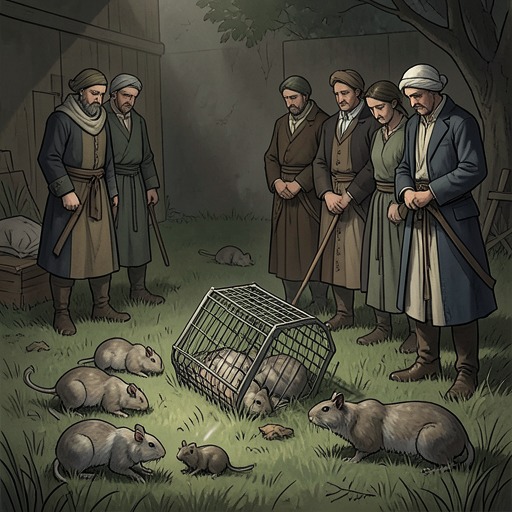
The chinchillas are lost one Friday night. After the wild dogs have eaten sheep’s offal, they force their way through the back fence, overturn the row of cages, and seize the animals, swallowing or tearing them apart before disappearing. Schatzie barks at the front of the store. Fidelis, occupied with checking for burglars and testing the locks, does not discover the attack as it happens. By the time the family sees the damage, the dogs have left only tracks and scattered, broken cages.
Aftermath and significance
Markus brings the news to Delphine first the next morning, when she enters the shop. He is crying and carries a scrap of fur; in the yard, the cages are scattered and ripped open, and no chinchillas remain. The expected earnings are gone, but Delphine recognizes another loss: the animals were also Eva’s unusual legacy to the boys, a project their mother had begun. Their destruction therefore breaks both a business plan and a connection to the last period of Eva’s life.
Fidelis responds by telling his sons to be quiet and placing a hand on each of their shoulders. He then gathers spoiled and unsalable meat, puts it at the edge of the field, and prepares rifles, ammunition, food, and beer beneath a tree where he can watch the bait. His response turns the attack into a confrontation with the wild dogs, although the chinchillas themselves cannot be restored. The animals’ episode thus moves from Eva’s attempt to create a diversion, through the boys’ investment in care and profit, to a loss that draws the family into Fidelis’s deliberate response. It also makes the household’s divided relation to animals visible: affection and close attention coexist with their valuation as meat, fur, or income.